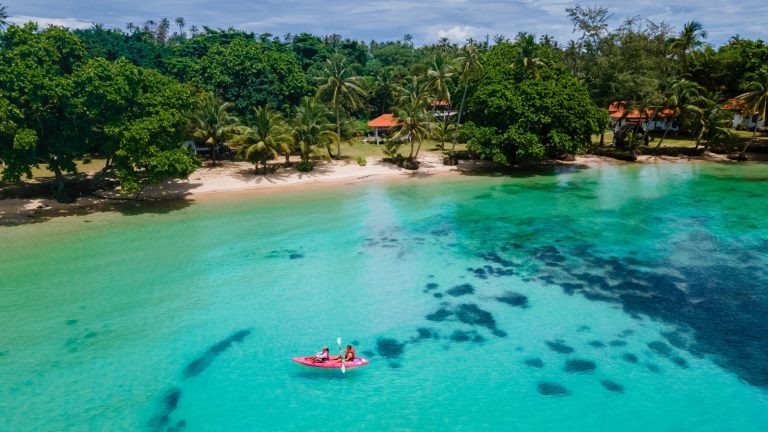
Thailand’s islands are among the country’s biggest attractions. White-sand beaches, warm seas, coral reefs and laid-back communities make it easy to understand why millions of visitors include an island stay in their holiday. But islands also face particular challenges. Fresh water and land can be limited, waste has to be managed in a confined space, and coral reefs and other marine habitats are sensitive to human activity. On smaller islands especially, visitor numbers can place additional pressure on infrastructure and local resources.

That doesn’t mean responsible travellers should avoid Thailand’s islands. Far from it. Making thoughtful choices about where you stay, how you travel and what you do while you are there can help reduce your impact while still enjoying everything an island holiday has to offer.
Choose your island carefully
There is no simple rule that says a quiet island is more responsible than a popular one. Larger destinations may receive many more visitors, but they may also have better infrastructure for managing water, wastewater, and rubbish. Smaller islands may appear unspoilt, but their limited resources can make them particularly vulnerable to sudden increases in visitor numbers.
Instead of choosing an island simply because it is described as ‘untouched’ or ‘off the beaten track’, research it before travelling. Think about how you will get there, where you will stay and what activities are available. Where possible, spend more time in fewer places. Staying for several nights rather than racing through three or four islands gives you more opportunity to get to know the destination and support local businesses while reducing the number of transfers you make.
Think about how you get there
Island travel in Thailand can sometimes involve several stages, particularly when combining destinations. Domestic flights, road transfers, ferries and speedboats can all form part of the journey. Travelling responsibly doesn’t mean avoiding these journeys altogether. Instead, consider whether each transfer is necessary and whether you can plan your itinerary more efficiently.
If you are planning an island-hopping holiday, grouping nearby islands can make more sense than travelling long distances across Thailand to reach another set of islands. And instead of treating every nearby island as another place to tick off your list, consider choosing one or two and staying longer. A slower itinerary can also make for a better holiday. You spend less time packing, checking out of hotels, and sitting on boats, and more time actually enjoying where you are.

Choose accommodation with care
Your choice of accommodation can make a significant difference, particularly on an island where resources may be limited. Look beyond claims such as ‘eco’, ‘green’ and ‘sustainable’ and see what the property is actually doing. Does it employ local people? Does it have measures to reduce water and energy consumption? How does it deal with wastewater and rubbish? Are refill stations available? Does it work with local suppliers and businesses?
The location also matters. A beachfront resort isn’t automatically irresponsible, but responsible development should consider the surrounding environment rather than damaging dunes, mangroves, or other natural habitats just to give guests an uninterrupted sea view. You can also make simple choices during your stay. Reusing towels, declining unnecessary linen changes and switching off air-conditioning when you leave your room all help reduce resource use.
For more detailed advice, see our guide to how to choose responsible accommodation in Thailand.
Be mindful of water use
When you’re surrounded by the sea, it’s easy to take water for granted. But seawater doesn’t solve the freshwater supply problem. On some Thai islands, freshwater resources are limited, and demand increases when visitor numbers are high. Hotels and resorts also use water for swimming pools, gardens, laundry, cleaning and guest rooms.
Nobody expects you to spend your holiday counting every litre of water you use. Simple habits can still make a difference: avoid unnecessarily long showers, reuse towels when practical and don’t request fresh bed linen every day unless you need it. If your accommodation explains that water is particularly scarce locally, take that advice seriously.
Reduce the waste you bring with you
One of the challenges of island tourism is straightforward: almost everything taken onto an island eventually has to be reused, recycled, processed or removed again. However, you can reduce some of that pressure before you even arrive. Carry a reusable water bottle and use refill stations where available. Bring a reusable shopping bag. Decline straws, plastic cutlery and extra bags when you don’t need them. If you use small travel toiletries, consider refillable containers rather than buying new miniature bottles for every trip.
Be particularly careful with items such as batteries and electronics. Don’t leave hard-to-dispose-of waste behind on a small island if you can take it somewhere with better facilities to handle it. You won’t have a zero-waste holiday, and you don’t need to. The aim is simply to avoid creating unnecessary waste.
Protect coral reefs and marine life
Snorkelling and diving are highlights of many Thai island holidays, but coral reefs are fragile ecosystems. Never stand on or touch coral, even if it appears dead. Keep your fins under control when snorkelling or diving and avoid kicking up sand or sediment around reefs. Don’t break off coral or take pieces home as souvenirs.

The same principle applies to marine wildlife. Observe animals without chasing, touching or feeding them. Seeing a turtle, reef shark or other marine animal in its natural environment should be memorable precisely because it is a wild encounter. Listen to instructions from responsible guides and follow regulations when visiting national parks and protected marine areas. If you’re inexperienced at snorkelling, tell your guide. Using a flotation device where appropriate can be much better than repeatedly trying to stand up on a reef.
For more practical advice, read our guide to protecting Thailand’s coral reefs.
Choose boat trips and marine activities carefully
A photograph in a glossy brochure and the word ‘eco’ don’t tell you much about how responsibly a tour actually operates. Before booking a snorkelling, diving or wildlife trip, look at what the operator says about protecting the environment. Responsible operators should provide clear guidance about behaviour around reefs and wildlife and should be prepared to intervene if guests ignore it.
Avoid activities that depend on feeding, touching or chasing wild animals to guarantee close encounters. Group size is another consideration. Smaller groups aren’t automatically sustainable, but overcrowded boats and large numbers of visitors entering the water at the same location can put additional pressure on popular sites. A good operator should want visitors to enjoy the marine environment without damaging what they came to see.
Spend locally
Responsible island travel isn’t only about the environment. Tourism can provide important income for island communities, and where you spend your money matters. Eat at locally run restaurants and food stalls as well as at your hotel. Visit local markets. Buy locally made products where possible, and use independent businesses for services such as transport, activities, and laundry.
That doesn’t mean you have to spend every baht with a small business. It simply means making room in your holiday for local businesses, rather than keeping all your spending within your resort. Food is one of the easiest ways to do this. Instead of eating every meal at your accommodation, try local restaurants, markets and family-run places. Apart from supporting the local economy, it is usually a much more interesting way to experience the island.

(Photo: Roy Cavanagh)
Remember that islands are communities too
It’s easy to think of an island primarily as a holiday destination. For the people who live there, it is home. The same cultural considerations that apply elsewhere in Thailand don’t disappear at the beach.
Swimwear is fine on the sand or around the pool, but cover up when visiting villages, shops, temples and other community spaces. Keep noise to reasonable levels, particularly around residential areas, and ask permission before taking close-up photographs of people.
Not everyone you meet works in tourism, and everyday life continues alongside the resorts, beach bars, and tour boats. Taking time to recognise that can change the way you experience an island.
Make your day at the beach lighter on the island
A day on a Thai beach doesn’t require complicated rules. Most responsible behaviour comes down to common sense. Take your rubbish with you if there isn’t a suitable bin. Don’t leave cigarette ends in the sand. Avoid abandoning inflatable toys, broken beach equipment or other items that somebody else will have to dispose of.
Don’t collect coral, shells or other natural objects from protected areas. What seems like an insignificant souvenir can become significant when thousands of visitors do the same thing.
You may also see organised beach clean-ups during your stay. Joining one can be worthwhile, particularly when it is led by a local community or conservation organisation. But picking up rubbish isn’t a substitute for reducing the amount of waste generated in the first place.
Stay longer and experience more
One of the simplest ways to rethink an island holiday is to stop trying to see every island. Thailand has dozens of islands that are worth visiting, but that doesn’t mean you need to visit them all on the same trip. Spending longer in one place reduces the number of transfers you make and gives you more opportunities to eat locally, explore beyond the main beach and learn something about the community. It can also make your holiday more enjoyable. Instead of constantly checking ferry schedules and packing bags, you have time to find a favourite restaurant, revisit a beach or simply have a day with nothing planned. Responsible travel doesn’t always require doing something extra. Sometimes it means doing less.
Your responsible island travel checklist

(Photo: Alex Trang / Shutterstock)
Before you go
Research the island rather than choosing purely from social media images. Look carefully at accommodation and tour operators, pack a reusable bottle and bag, and plan an itinerary that avoids unnecessary transfers.
While you’re there
Use water thoughtfully, refill rather than continually buying new plastic bottles where practical, support local businesses and respect communities away from the beach. When snorkelling or diving, keep your distance from wildlife and never stand on or touch coral.
Before you leave
Dispose of rubbish responsibly and take difficult-to-process waste with you where appropriate. Leave shells, coral and other natural objects where you found them.
Small choices can make a difference
Travelling responsibly doesn’t mean giving up what makes a Thai island holiday special. You can still swim, snorkel, eat seafood, take boat trips, stay in beautiful accommodation and spend lazy days on the beach. The goal isn’t a perfect, impact-free holiday. No trip is. Instead, think about the choices within your control: how often you move around, where you stay, which businesses you support, how you use limited resources, and how you behave around wildlife and local communities.
Thailand’s islands are places to enjoy. Travelling thoughtfully can help ensure the people and natural environments that make them special also benefit from tourism.