Thailand’s northeastern region of Isaan is often overlooked by tourists, but this corner of Thailand has much to offer discerning travellers with historic sites, diverse cuisine, and colourful festivals. And thanks to an affordable and efficient rail network connecting Isaan’s major towns and cities, exploring this culturally rich area by train is convenient, enjoyable, and a low-carbon way to travel. With minimal crowds and maximum charm, Isaan invites travellers to take their time and discover a side of Thailand that remains largely off the tourist radar.

(Editorial credit: Amnat Phuthamrong / Shutterstock.com)
Taking at least two weeks to explore this corner of Thailand by train is ideal for those seeking a more authentic experience. From ancient ruins and national parks to lively towns and serene countryside, you’ll visit key destinations such as Khao Yai National Park, Nakhon Ratchasima (Korat), Phimai, Khon Kaen, Udon Thani and Nong Khai, with all of these locations easily reached by train.
Bangkok
The starting point for your Isaan railway adventure is Bangkok’s Krung Thep Aphiwat Central Terminal. Long-distance trains on the Northeast railway route (covering Isaan) moved here in 2023, having previously operated from the old station at Bangkok Hua Lamphong.

Pak Chong
A three-hour train ride from Krung Thep Aphiwat Central Terminal leads you to Pak Chong, the gateway town for Khao Yai National Park, Thailand’s oldest and one of its most biodiverse reserves.

Many guesthouses in the Khao Yai area offer transfers from Pak Chong train station. You can choose to unwind in the town or (if you take the early morning train from Bangkok) dive straight into adventure with an afternoon wildlife tour or a night safari in the park. Camping overnight in Khao Yai is also an option for nature lovers.

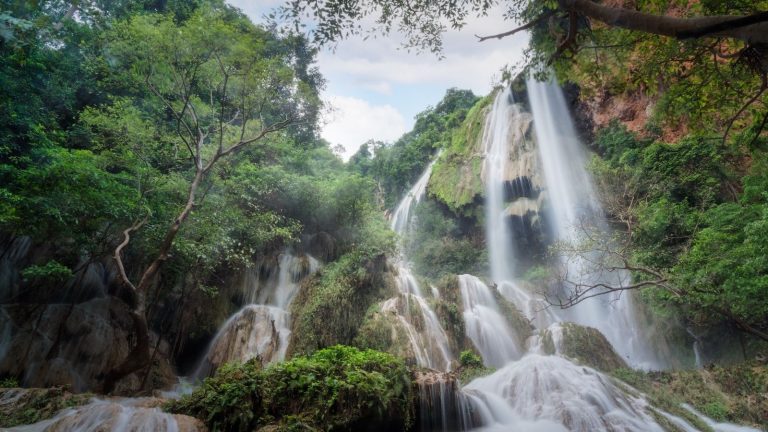
On your second day, take a full-day guided tour of the park. A UNESCO World Heritage Site, Khao Yai is a haven for wildlife enthusiasts, offering chances to see gibbons, hornbills, and even wild elephants. Trek to Haew Suwat Waterfall, made famous by The Beach, and consider activities like white-water rafting at Kaeng Hin Phoeng during the rainy season. Local guides are recommended to enhance your wildlife-spotting opportunities.

Nakhon Ratchasima (Korat)
From Pak Chong, it’s just a two-hour train ride to Nakhon Ratchasima. Known locally as Korat, this lively city marks the beginning of your deeper dive into Isaan culture. Start your visit at the Thao Suranari Monument, honouring the 19th-century heroine Ya Mo, who defended the city from invading forces. An annual festival (late March to early April) is held in her honour to celebrate her legacy.

(Photo: ThewayIsee / Shutterstock.com)
No visit to Isaan would be complete without sampling the region’s bold cuisine. Tuck into som tam (spicy papaya salad), gai yang (grilled chicken), and sticky rice. Don’t miss regional favourites like larb moo (spicy minced pork) and sai krok Isaan (fermented sausages).

(Photo: Roy Cavanagh)
Phimai Historical Park
Take a local bus for the one-hour trip to Phimai. Though it’s possible to do as a day trip, staying overnight lets you soak in the charm of this friendly small town. The Phimai Historical Park houses one of Thailand’s finest examples of Khmer architecture, with temple ruins that predate Cambodia’s Angkor Wat.

Nearby, visit Sai Ngam, a vast grove of banyan trees spreading over 1,300 square metres. Walk under the twisted roots and branches, some believed to be centuries old. Local legend holds that these trees are home to guardian spirits, and offerings are still made at the site.
From Phimai, return to Nakhon Ratchasima by bus and board a train for the 4.5-hour journey to Khon Kaen.
Khon Kaen
Khon Kaen is an important centre for education and culture in Isaan and the city has a youthful, energetic vibe thanks to its university population. Khon Kaen is also home to the excellent Ad Lib Khon Kaen Hotel, runner-up in the 2024 Responsible Thailand Awards in the Responsible Community Tourism category.

(Photo: Pratan Saetang / Shutterstock.com)
Explore the Khon Kaen National Museum for insights into the region’s prehistoric and modern history. In the evening, head to Bueng Kaen Nakhon, a tranquil lake surrounded by parks and food stalls, perfect for a casual stroll and a bite to eat.

Visit Wat Nong Wang, a spectacular nine-tiered temple overlooking the city. Each floor has displays detailing Buddhist teachings and local traditions, and the top level offers sweeping panoramic views. Look down to spot dinosaur motifs in the floor tiles, which are a nod to the region’s paleontological past.
If time allows, take a day trip to nearby Phu Wiang National Park. This area is famous for dinosaur fossil discoveries, and the on-site museum is both educational and fun for all ages.
Udon Thani
From Khon Kaen, a 2.5-hour train ride takes you to Udon Thani. Begin your visit at Nong Prajak Park, a green oasis in the city with a scenic lake and landscaped gardens. For food and entertainment, head to UD Town, a buzzing complex of restaurants, food stalls, and live music.

(Photo: Nutty Nuttpol Phongsart / Shutterstock.com)
Discover Udon Thani’s ancient roots at Ban Chiang, a UNESCO World Heritage Site. This archaeological site contains pottery and artefacts dating back over 5,000 years and offers a glimpse into one of Southeast Asia’s earliest civilisations.

(Photo: Artigone Pumsirisawas / Shutterstock.com)
Make time for Phu Phrabat Historical Park, home to mystical rock formations and religious relics dating from the Dvaravati period. Another highlight is Wat Pa Phu Kon, set atop a forested hill and featuring an enormous marble Reclining Buddha.

(Photo: Copyright of the Tourism Authority of Thailand [TAT])
If you’re travelling between December and February, don’t miss the Red Lotus Sea at Kumphawapi. Thousands of lotus flowers bloom across the lake, and early morning boat rides offer breathtaking views and photo opportunities.

Nong Khai
From Udon Thani, continue your journey north by train to Nong Khai, a peaceful town on the banks of the Mekong River. Rent a bicycle and ride along the promenade or relax at a riverside café with views across to Laos.

(Photo: Roy Cavanagh)
Visit the surreal Sala Kaew Ku Sculpture Park, filled with towering statues influenced by Buddhism and Hinduism. For a different perspective, head to Wat Pha Tak Seua and its glass skywalk for panoramic views over the Mekong.
End your journey with a train ride back to Bangkok from Nong Khai or continue into Laos via the nearby border crossing. Flights from Udon Thani to Chiang Mai or Bangkok are also available.
Practical tips for train travel in Isaan
Thailand’s trains offer three classes. Third class is fine for short hops, offering open windows and great views, though it can be hot. For longer trips, second class with air-conditioning and reclining seats is a more comfortable option.
Train tickets for the local, ordinary trains can be purchased at the station on the day. For long-distance routes, including the Nong Khai to Bangkok sleeper train, book in advance via the State Railway of Thailand (SRT) website . You do need to register to use the service and feedback from some users say it can be a frustrating site to use. Tickets can also be purchased in person at any SRT station in Thailand.